The Making Of
Building


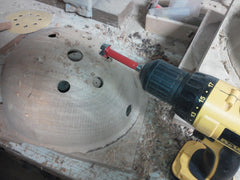
Helmet blocks come from all sorts of wood sources, though, of course, ultimately they all come from trees. Lots of saws and heavy lifting. The blocks are precision machined via CNC Router using Computer Aided Modelling to customize shape and size. Once the "blank" is created vent holes are hand drilled using carbide Forstner bits.
 .
. 
During this phase each helmet is impregnated on the inner shell surface with Dragonshield Polyurea to improve durability and impact absorption. Check it out in this quick clip
Finishing
Each shell is hand shaped and finished. Cracks and natural imperfections are filled with a clear gap filling epoxy that retains the natural aesthetic and character of the particular piece while actually making it structurally more sound than it would have been without the imperfection. Shells are sanded to 220 grit before they are sealed.
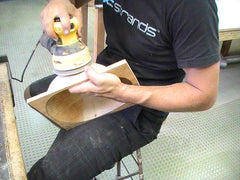
The sealing process begins with three coats of epoxy to make them watertight as well as to give them durability and abrasion resistance. Then the epoxy is protected from UV damage by three coats of Linear Polyurethane which also provides excellent protection against abrasion. This is similar to the durable finish applied to new cars.
Assembly
Cork sheets are laser cut to create a perforated pattern that better absorbs energy in impacts. These sheets are fitted, by hand, to the inner shell in 3 layers.


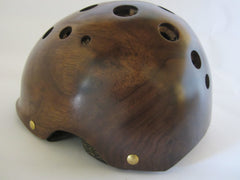
Finally, the harness is attached using solid brass screw posts and the fit/comfort pads are laser cut and glued in to finish the helmet.